Found By Accident contains affiliate links and is a member of the Amazon Services LLC Associates Program. If you make a purchase using one of the Amazon links (or other affiliate links), we may receive compensation at no extra cost to you. See our disclosure policy for more information.
Think You’ve Seen A Carnival Before? These 15 Events Will Completely Change Your Mind
National Carnival Day falls on February 26th each year, offering a dedicated moment to recognize one of humanity’s most exuberant traditions. And while this specific date might highlight the festivities on a calendar, the true spirit of carnival is a global phenomenon that happens all year long.
From the heat of summer in the Caribbean to the winter chills of Europe, cities worldwide transform their streets into open-air theaters at different times of the year.
Attending one of these festivals gives you a distinct connection to a destination that you simply cannot get during a standard vacation. You see the pride in the craftsmanship of the costumes and feel the energy that has been building up for months within the local neighborhoods.
It is a time when the usual rules of daily life fade away, replaced by rhythm, satire, and spectacle.
If you want to experience a culture at its most vibrant, aligning your travel plans with a major carnival is an excellent strategy. The world offers a staggering variety of these events, ensuring that no matter when you travel, there is likely a celebration waiting for you.
Trinidad And Tobago Carnival, Trinidad And Tobago
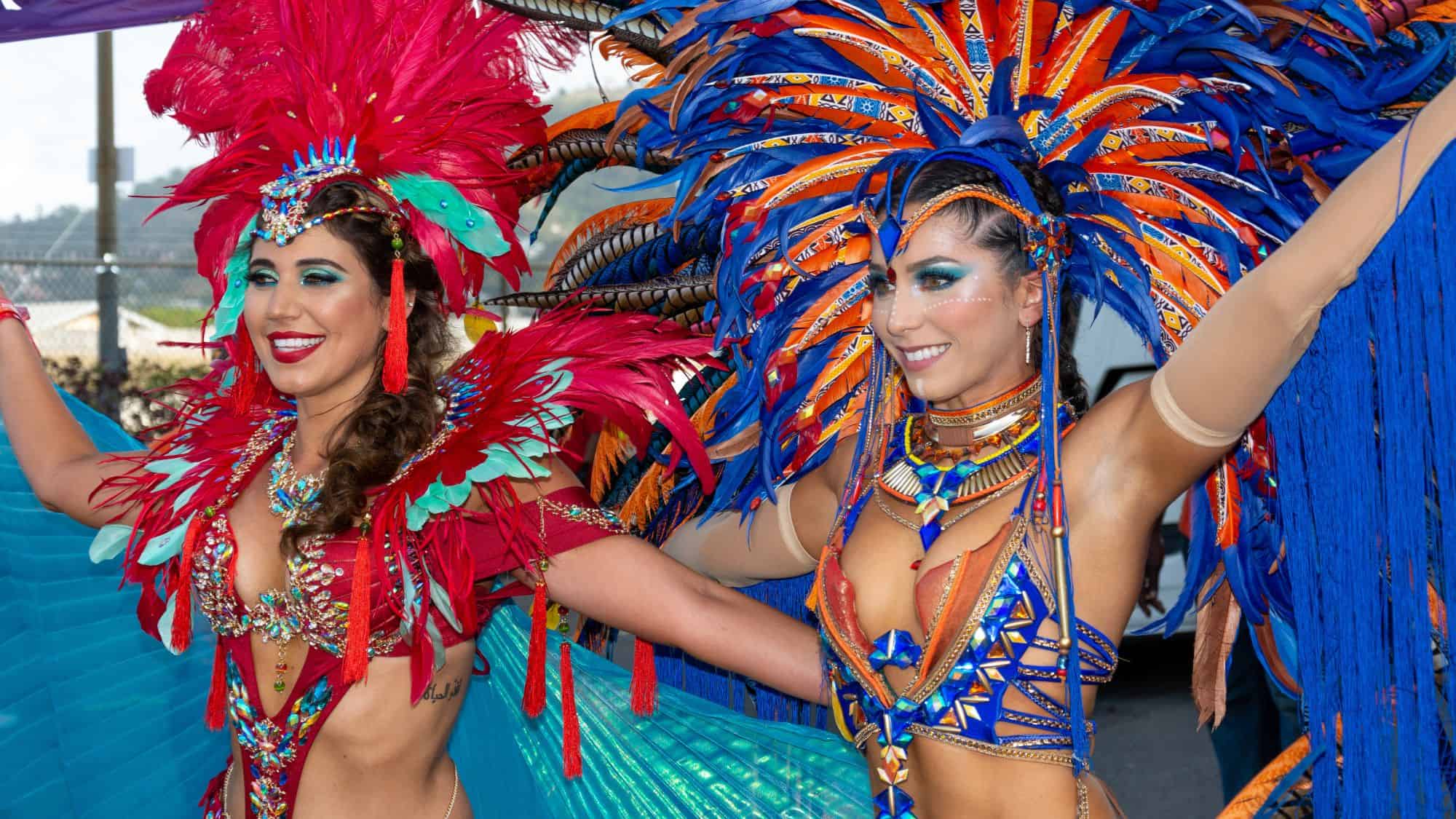
If you are looking for the greatest street party in the Caribbean, Trinidad and Tobago Carnival is the undisputed champion.
This explosion of energy is widely known as the “Mother of all West Indian Carnivals,” setting the standard for Caribbean festivals worldwide. And the celebration is not a spectator sport; it is an interactive experience where you are encouraged to join the bands and dance through the streets of Port of Spain.
The festivities technically span the Monday and Tuesday before Ash Wednesday, but the buildup, known as “fete season,” starts right after Christmas, filling the islands with competitions, parties, and concerts.
A defining feature of this celebration is J’Ouvert, which takes place in the pre-dawn hours of Carnival Monday. During this primal opening ceremony, revelers cover themselves in oil, mud, paint, or chocolate, dancing through the streets in the dark to the infectious rhythm of soca and calypso music.
It is a chaotic, liberating experience that stands in stark contrast to the glamour that follows.
Later in the day and on Carnival Tuesday, the “Mas” (masquerade) bands take over, showcasing costumes that can cost thousands of dollars and feature intricate wire-bending techniques and massive feather plumes.
Carnival Of Santa Cruz De Tenerife, Canary Islands (Spain)

Located off the coast of Africa, the Spanish island of Tenerife hosts a carnival so spectacular that it is widely considered the second most popular in the world, right after Rio de Janeiro.
For two weeks, the capital city of Santa Cruz transforms into a non-stop festival of rhythm, color, and satire. The weather here is almost always spring-like, which allows for skimpy, dazzling costumes and outdoor parties that last until dawn.
The atmosphere is distinctively European yet infused with a tropical Latin energy, creating a unique fusion that attracts hundreds of thousands of visitors from across the globe.
The crown jewel of the festival is the Gala for the Election of the Carnival Queen. This is not a typical beauty pageant; the candidates wear “fantasies” (costumes that can reach over 16 feet in height and weigh more than 350 pounds).
These massive structures are so heavy that they are mounted on wheeled chassis, and the contestants must glide across the stage with grace despite the immense weight. It is a breathtaking display of engineering and design that is broadcast internationally.
Rio Carnival, Brazil

When people think of carnival, the image that usually springs to mind is the Rio Carnival in Brazil. It is the gold standard for extravagance, a sensory overload of samba, sequins, and sweat that captivates the entire world.
The energy in Rio de Janeiro during this period is palpable, with the entire city pulsating to the beat of drums.
While street parties known as “blocos” happen all over the city, organized by neighborhoods and attracting millions, the main event is the fierce competition held at the Sambadrome. This purpose-built stadium hosts the top samba schools as they parade down a 700-meter runway in a bid for the championship title.
The Sambadrome Marquês de Sapucaí was designed by the famous modernist architect Oscar Niemeyer and inaugurated in 1984, providing a permanent home for the parade, which had previously choked city streets.
During the main nights of the competition, samba schools (which are actually community organizations from Rio’s favelas and suburbs) present themed processions involving thousands of dancers, drummers, and gargantuan floats.
Each school has roughly 80 minutes to traverse the avenue, and they are judged on everything from rhythm and flow to costume details.
Venice Carnival, Italy

Venice Carnival offers a completely different vibe from the frenetic energy of the Caribbean or South America. Here, the atmosphere is one of mystery, elegance, and historical romance.
Set against the backdrop of ancient canals and crumbling palazzos, this festival feels like stepping back into the 18th century. The focus is on the mask, specifically the “maschera Nobile,” which historically allowed citizens to hide their identity and social status, enabling commoners and aristocracy to mingle illicitly.
Today, the costumes are works of art, featuring elaborate velvet, silk, and brocade fabrics that turn St. Mark’s Square into an open-air theater.
One of the most anticipated events is the “Flight of the Angel” (Volo dell’Angelo), which officially opens the festivities.
During this spectacle, a costumed woman descends on a zipline from the campanile of St. Mark’s Basilica to the middle of the square, a tradition that dates back to the mid-16th century when a Turkish acrobat first walked a tightrope to the bell tower. It is a heart-stopping moment that draws tens of thousands of onlookers who pack the piazza to witness the descent.
Mardi Gras, Louisiana

New Orleans Mardi Gras is the most famous carnival celebration in the United States, a chaotic and colorful final hurrah before Lent.
While the name technically refers only to “Fat Tuesday,” the carnival season actually begins on January 6th, the Feast of the Epiphany. The city becomes a playground of parades, balls, and street parties, where the air is thick with jazz music and the smell of Cajun cuisine.
Unlike many other carnivals where you watch from a distance, here the interaction between the floats and the crowd is essential, centered on the frantic begging for “throws” (trinkets tossed by the krewe members).
The parades are organized by “krewes,” social clubs that fund and build the floats. Some of the most historic include the Krewe of Rex and the Krewe of Zulu.
The Krewe of Zulu is famous for its highly prized throw, the Golden Coconut (or “Zulu Coconut”), which are hand-painted coconuts handed out to lucky spectators. Because of liability concerns, these heavy items are generally handed down rather than thrown from the floats.
Another key tradition involves the specific colors of Mardi Gras: purple (justice), green (faith), and gold (power), which were established by the Rex organization in 1872.
Carnival Of Binche, Belgium

For a carnival experience that is steeped in folklore and feels incredibly distinct from the sequined spectacles elsewhere, you should head to the medieval town of Binche in Belgium.
In fact, this celebration is so unique and culturally significant that UNESCO recognized it as a Masterpiece of the Oral and Intangible Heritage of Humanity in 2003.
The festival is governed by strict traditions that have remained largely unchanged for centuries, focusing on unity and the driving away of winter. And the atmosphere here is less about partying and more about participating in a solemn, rhythmic ritual that binds the community together.
The central figures of the carnival are the “Gilles.” On Shrove Tuesday, roughly 1,000 local men dress in vibrant red, yellow, and black costumes stuffed with straw to give them a hunched appearance. They wear wooden clogs and heavy bells attached to their belts.
In the morning, they wear wax masks with green spectacles and small mustaches, which they are forbidden from removing until the afternoon. This specific mask design is patented and cannot be worn outside of Binche or on any other day.
The highlight comes in the afternoon when the Gilles don massive hats made of ostrich feathers (some weighing nearly seven pounds) and march through the town tossing blood oranges to the crowd. Catching an orange is considered a sign of good luck.
Nice Carnival, France
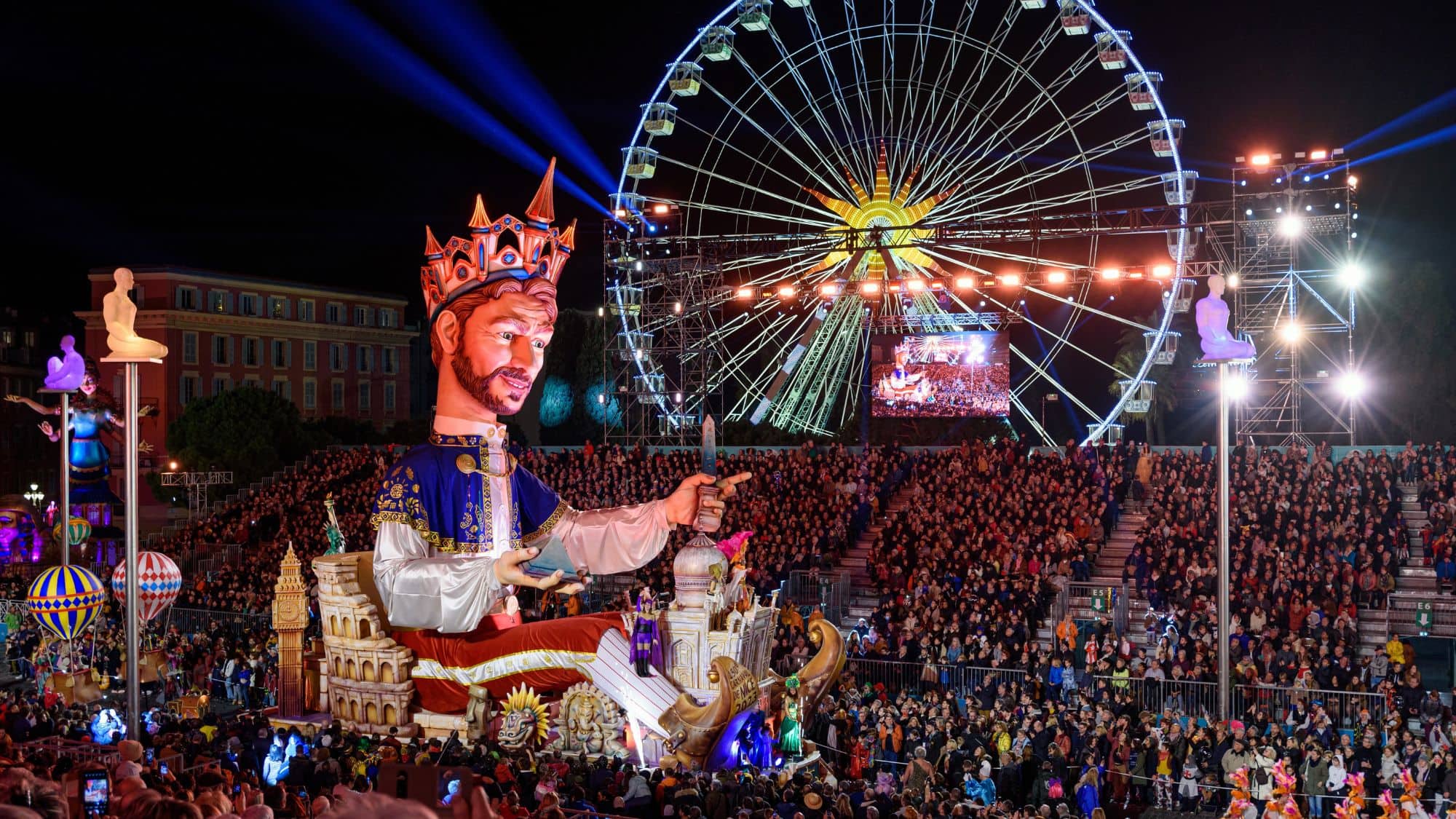
The French Riviera provides a stunning backdrop for the Nice Carnival, the premier winter event on the Cote d’Azur.
Running for two weeks in February, this festival combines the artistic elegance of France with a playful, satirical edge.
The carnival revolves around two main types of parades: the Carnival Parade, featuring 17 massive floats that often mock political figures and pop culture, and the Flower Battle (Bataille de Fleurs). The latter is unique to Nice and highlights the region’s rich floral heritage, with locally grown mimosas, lilies, and roses covering the floats.
During the Flower Battle, costumed models on the floats throw roughly 100,000 cut flowers to the crowds lining the Promenade des Anglais. This tradition began in 1876 as a simple exchange of flowers to entertain tourists, but has evolved into a prestigious display of local horticulture.
It is estimated that 85% of the flowers used are produced locally in the region, supporting the area’s growers. You can expect to leave these parades with armfuls of fresh blooms, making it one of the most fragrant and beautiful carnival experiences in the world.
The theme of the carnival changes every year, but is always centered on the “King of Carnival.” On the final night, the massive King float is towed out to sea or placed in the Place Massena and burned in a spectacular bonfire, signaling the end of winter and the coming of spring.
Cologne Carnival, Germany

In Germany, the Cologne Carnival is referred to as the “Fifth Season.” While the main street events happen in February, the season officially kicks off at 11:11 AM on the 11th day of the 11th month (November).
However, the “Crazy Days” that culminate the season are where the real action is. For six days, normal life in Cologne grinds to a halt. Pubs stay open late, the streets are packed with costumed revelers, and the local dialect, Kolsch, is heard everywhere.
The rallying cry “Kolle Alaaf!” (Cologne above all!) echoes through the city as locals and tourists alike celebrate with abandon.
The climax is Rose Monday (Rosenmontag), featuring a parade that stretches for four miles and includes over 10,000 participants. The floats are famous for their biting political satire, often featuring caricatures of German and international politicians in compromising or ridiculous situations.
These papier-mache figures are designed to be provocative and are a hallmark of the region’s freedom of expression. During the parade, roughly 300 tons of candy (Kamelle) and thousands of bouquets of flowers are thrown to the spectators.
Carnival Of Cadiz, Spain

If you value wit and humor over flashy costumes, the Carnival of Cadiz in Andalusia is the place for you. It is widely regarded as the funniest carnival in the world, where the power of words takes center stage.
The streets of this ancient port city turn into an open-air stage for groups of musicians known as “chirigotas” and “comparsas.” These groups roam the streets singing satirical songs that poke fun at everything from current events and politicians to celebrity gossip and everyday life.
The humor is sharp, the lyrics are clever, and the primary goal is to make the audience laugh.
The official competition takes place in the Gran Teatro Falla, where groups compete for weeks before the street party begins. However, the “ilegales” (illegal groups) are just as popular; these are amateur bands that don’t enter the official contest but perform on street corners, often drawing huge crowds.
It is recognized as a Festival of International Tourist Interest, and the entire city, which is one of the oldest in Western Europe, devotes itself entirely to the art of irony for ten days.
Carnival Of Viareggio, Italy

While Venice relies on history and mystery, the Carnival of Viareggio in Tuscany relies on sheer size and biting satire.
This coastal city is famous for hosting parades of the world’s largest and most complex moving floats. These are not just decorated platforms; they are massive feats of engineering, rising over 65 feet high and weighing up to 40 tons.
They are built at the Cittadella del Carnevale, a colossal complex dedicated entirely to the creation of these floats. And the artisans here are so skilled that they often work on movie sets and theater productions throughout the rest of the year.
The subject matter in Viareggio is fiercely political. The floats are giant caricatures that offer scathing social commentary on Italian politics, environmental issues, and global affairs.
Seeing a five-story-tall papier-mache effigy of a world leader moving its eyes and limbs via complex hydraulic systems is an awe-inspiring and often unsettling experience.
A strong musical connection exists here as well. The carnival’s official mascot is Burlamacco, a clown-like figure created in 1930, but the city is also the home of the legendary opera composer Giacomo Puccini.
It is common to hear opera music blasting from the floats alongside modern pop hits, creating a surreal blend of high culture and low-brow satire.
Carnival Of Basel, Switzerland
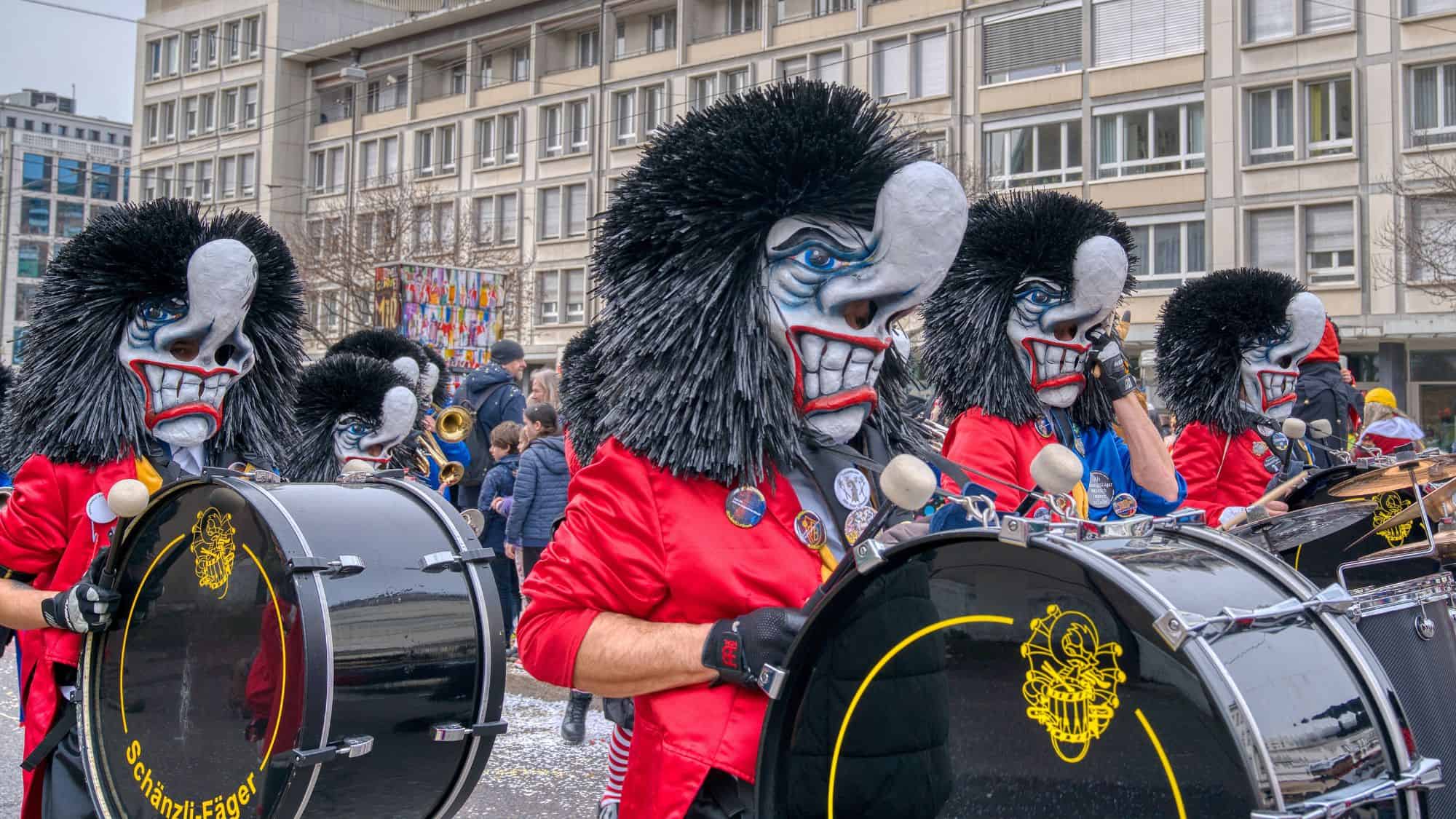
The Carnival of Basel (Basler Fasnacht) is the largest in Switzerland and arguably the most disciplined and structured carnival in the world. It begins precisely at 4:00 AM on the Monday after Ash Wednesday, a timing that sets it apart from Catholic traditions that end on Shrove Tuesday.
This event, known as “Morgestraich,” is a magical experience. The city lights are turned off, plunging the streets into darkness, and the only light comes from huge, hand-painted lanterns carried by the cliques (fife and drum bands).
The silence is broken only by the command “Morgestraich, vorwarts, marsch!”(Morgestraich, forward, march!) followed by the thunderous sound of thousands of piccolos and drums.
This festival has been recognized by UNESCO for its unique cultural heritage. And unlike the chaotic parties elsewhere, the participants here are separated from the spectators. The audience watches from the sidewalks while the masked participants march in formation.
The lanterns are significant; they are painted with scenes depicting the events of the past year, serving as a visual retrospective and satire of local and global news.
Another distinct element is “Guggenmusik,” brass bands that play loud, intentionally off-key renditions of popular songs. They perform mainly on Tuesday evening and provide a boisterous counterpoint to the disciplined fife and drum cliques.
Carnival Of Oruro, Bolivia

High in the Andes mountains, at an altitude of over 12,000 feet, the Carnival of Oruro offers a spectacular fusion of indigenous Andean traditions and Catholic rituals.
This festival is a testament to religious syncretism, where pre-Columbian deities are venerated alongside Christian saints.
The main event is a pilgrimage to the Shrine of the Virgin of the Socavon (Virgin of the Mineshaft), featuring 20,000 dancers and 10,000 musicians performing for 20 hours straight along a two-and-a-half-mile route. The physical endurance required to dance in heavy costumes at this altitude is astounding.
The most famous dance is the “Diablada,” or Dance of the Devils. It represents the battle between good (Archangel Michael) and evil (Lucifer and the seven deadly sins).
The costumes are terrifyingly beautiful, featuring grotesque masks with bulging eyes, horns, and dragons, often adorned with mirrors and silverware. This dance originated from the miners who sought protection from the “Tio” (uncle), a devil-like deity who was believed to rule the underworld of the mines.
Because of its immense cultural value, UNESCO declared the Carnival of Oruro a Masterpiece of the Oral and Intangible Heritage of Humanity in 2001.
Goa Carnival, India

Goa is unique in India for its long history as a Portuguese colony, which lasted for over 450 years. And this influence is most visible during the Goa Carnival, the only major carnival celebration in India.
Held in February before Lent, it was introduced by the Portuguese in the 18th century and has since evolved into a distinct mix of Konkani and Western culture.
The festivities are presided over by “King Momo,” a locally selected resident who is given the key to the city and issues a decree for “Kha, piye, aani majja kar” (Eat, drink, and make merry).
The main float parades move through the major cities of Panaji, Margao, Vasco, and Mapusa over four days. While you will see samba-style dancers and floats, you will also see depictions of Goan village life and traditional folk dances like the Dekhni and Fugdi.
A traditional aspect of the carnival that is distinct to Goa is the “Red and Black Dance.” This is a formal ball held by the Clube Nacional in Panaji on the final day of the festivities.
Participants must dress in red and black attire, and they perform a synchronized dance involving confetti and live bands. It is a throwback to the colonial era’s social clubs and remains a prestigious event on the local calendar.
Carnival Of Barranquilla, Colombia

Colombia’s Carnival of Barranquilla is a massive folklore celebration that claims to be the second largest in the world behind Rio, though Tenerife might dispute that.
Regardless of rank, its cultural depth is undeniable. It is a melting pot of European, African, and Indigenous cultures, reflecting the diverse history of the Caribbean coast.
UNESCO recognized this diversity by naming it a Masterpiece of the Oral and Intangible Heritage of Humanity in 2003. And the slogan here is “Quien lo vive, es quien lo goza” (Those who live it are those who enjoy it), emphasizing active participation.
One of the most iconic characters you will see is the “Marimonda.” This unique figure wears a mask with a long nose and big ears, looking like a mix of a monkey and an elephant. It originated as a way for the poor working class to mock the stuffy high society officials of the early 20th century. Today, it is the symbol of the playful, rebellious spirit of Barranquilla.
The festival kicks off with the Battle of Flowers (Batalla de Flores), a parade that dates back to 1903. It was organized to celebrate the end of the Thousand Days’ War, transforming a country torn by conflict into one celebrating with flowers instead of bullets.
Carnival Of Las Palmas, Canary Islands (Spain)

While Tenerife focuses on feathers and grandeur, its neighbor Gran Canaria hosts the Carnival of Las Palmas, which is famous for its inclusivity and its spectacular Drag Queen Gala.
This event was the first carnival in Spain to introduce a Drag Queen competition in 1998, and it has since become one of the most important events of the festival, often overshadowing the traditional Queen election.
The contestants perform acrobatic choreography on massive platform boots, wearing costumes that are just as elaborate as they are daring. It highlights the open-minded and cosmopolitan nature of the city.
You should also know about the “Entierro de la Sardina” (Burial of the Sardine), which is particularly dramatic. The procession travels from the city center to Las Canteras beach, where the sardine is placed on a barge and burned at sea, followed by a massive fireworks display.
Like Our Content? Follow Us On MSN (or click the Follow Button above) to see more from Traveling In Focus.