Found By Accident contains affiliate links and is a member of the Amazon Services LLC Associates Program. If you make a purchase using one of the Amazon links (or other affiliate links), we may receive compensation at no extra cost to you. See our disclosure policy for more information.
12 Hidden Corners Of Barcelona That Prove The City Is More Than Its Famous Landmarks
Barcelona is a city that captures the imagination of travelers immediately with its whimsical architecture and lively street life. Most visitors flock straight to the famous landmarks that define the skyline, such as the towering Sagrada Familia or the bustling walkway of La Rambla.
While these sites are undeniably spectacular, they often come with shoulder-to-shoulder crowds and long waiting lines that can dilute the magic of the experience. And if you stick only to the main tourist trail, you might miss the quieter, more authentic pulse of the Catalan capital.
There is a different side to this Mediterranean metropolis that lies just around the corner from the souvenir shops and tour buses. Places where you can find pockets of silence in the middle of the Gothic Quarter or sweeping panoramic views where the only sound is the wind.
Exploring these underrated spots allows you to connect with the city’s history and local culture on a deeper level. It gives you space to breathe and appreciate the details that make Barcelona so unique.
Below, we are highlighting some locations that deserve your attention. By the end of it, you will find out that the true character of Barcelona often hides in plain sight, waiting for curious travelers to take a closer look.
El Born Cultural Center

The neighborhood of El Born is famous for its trendy boutiques and nightlife, but the El Born Cultural Center offers a striking look into the city’s layered history.
Housed inside the former Mercat del Born, which opened in 1876 as the first large-scale cast-iron market in the city, the building itself is a masterpiece of 19th-century industrial architecture.
When you walk through the expansive glass and iron structure, you are not stepping into a typical museum or gallery. Instead, you are looking down onto an archaeological site that reveals the Barcelona of three centuries ago.
Beneath the cast-iron pillars lie the ruins of the Vilanova neighborhood, which was demolished by the troops of King Philip V after the Siege of Barcelona in 1714. This destruction was ordered to build a military citadel to control the city, effectively burying a bustling district under the weight of war.
The site preserves the layout of the streets and houses exactly as they were at the start of the 18th century. You can walk around the perimeter of the excavation on raised walkways and peer into the remains of homes, workshops, and drainage systems that once supported vivid daily life.
Access to the building and the walkways is free, making it an excellent stop for travelers on a budget who want to understand Catalan heritage.
Antic Teatre
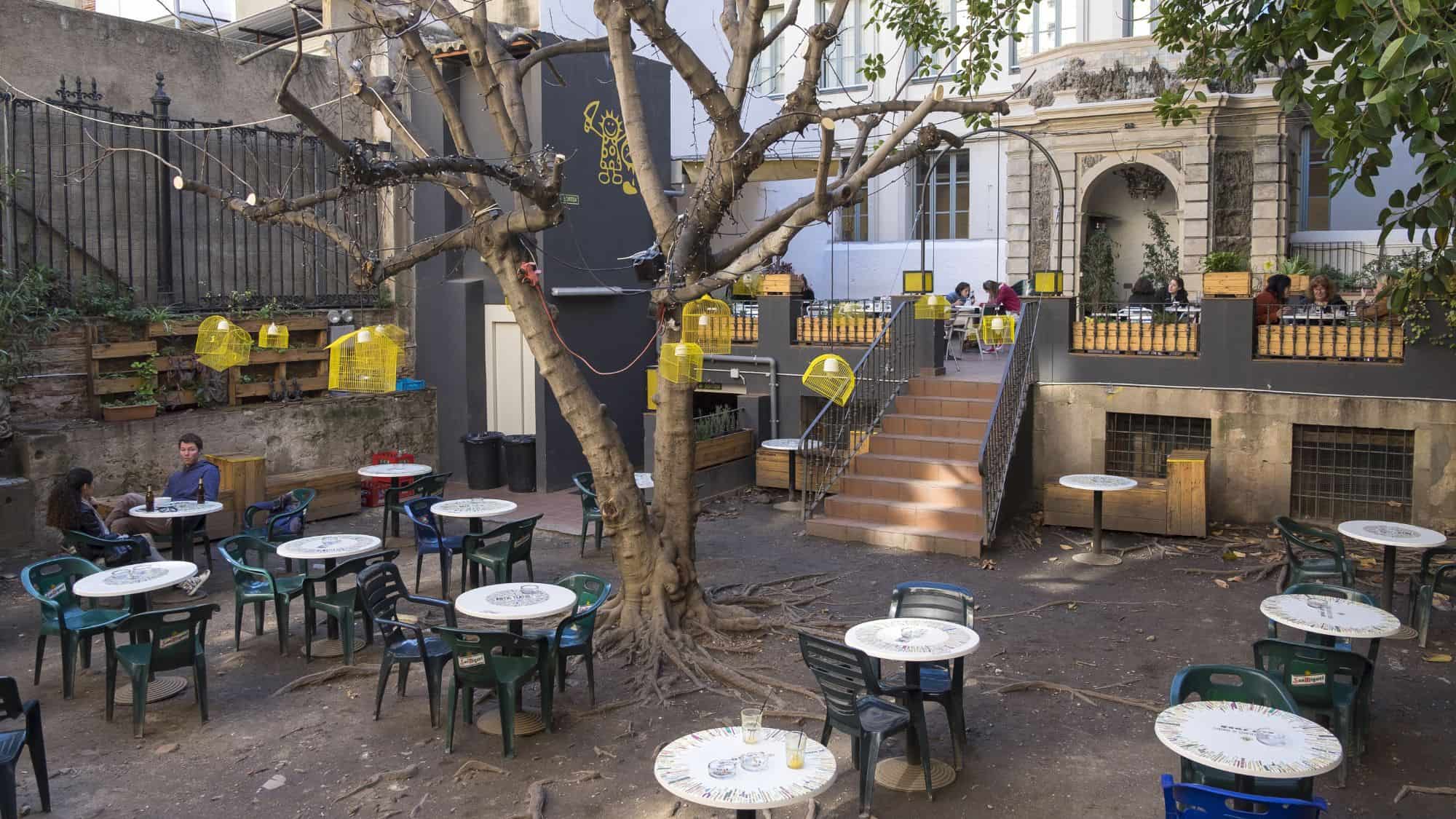
Finding a quiet space to have a drink in the center of Barcelona can feel like an impossible task, yet the Antic Teatre remains a local favorite that many tourists walk right past. Located just a few minutes from the stunning Palau de la Musica Catalana, this cultural center is hidden behind a modest doorway on a narrow street.
Once you step through the entrance and descend the stone stairs, the noise of the city fades away completely. You emerge into a large, open-air courtyard dominated by a massive, leafy tree that shades the entire terrace.
The building dates back to 1650 and has served various purposes over the centuries, including housing an amateur theater group.
Today, it operates as an independent social and cultural center dedicated to supporting experimental arts and community projects. The bar in the garden is the main revenue source for the center, meaning that every drink you purchase helps support local artists and the maintenance of the historic space.
The atmosphere is undeniably relaxed and bohemian, attracting a mix of students, artists, and neighbors who treat it as their communal living room. And prices here are significantly lower than the tourist traps surrounding the nearby cathedral, making it an economical choice for a midday break or evening gathering.
Bunkers Del Carmel

For the best views of Barcelona, many guidebooks will point you toward Park Guell or Tibidabo, but Bunkers del Carmel offer a 360-degree panorama that is arguably superior and completely free.
Located at the top of Turo de la Rovira in the Horta-Guinardo district, this site sits 860 feet above sea level.
The climb to the top is steep and requires some physical effort (or a ride on the V17 bus followed by part of the walk), but the reward is seeing the entire city grid stretch out to the Mediterranean Sea.
The history of this viewpoint is somber. The concrete structures you see are the remains of an anti-aircraft battery installed during the Spanish Civil War in 1937 to defend the city against fascist bombing raids.
After the war, the military abandoned the site, and it became a shantytown known as “Els Canons,” where waves of immigrants from other parts of Spain built makeshift homes. It was not until the lead-up to the 1992 Olympics that the shantytown was cleared, and in recent years, the city has renovated the area to explain its historical significance.
It is best to go just before sunset. You can watch the light change over the Sagrada Familia and the Agbar Tower as the city lights begin to flicker on, creating a magical atmosphere that feels far removed from the busy avenues below.
Sant Pau Art Nouveau Site

While millions of visitors stare up at the Sagrada Familia, very few make the ten-minute walk up Avinguda de Gaudi to see the Sant Pau Art Nouveau Site, a UNESCO World Heritage site that rivals any other modernist building in the city for beauty.
This architectural gem was a fully functioning hospital until 2009, which explains why it remained off the tourist radar for so long. Designed by Lluis Domenech i Montaner, a contemporary and rival of Gaudi, construction began in 1902 and resulted in the largest Art Nouveau complex in the world.
The complex consists of 27 separate pavilions set within tranquil gardens. Domenech i Montaner believed that fresh air, sunlight, and beauty were essential for healing patients, so he designed the hospital as a garden city.
The main administration pavilion is particularly stunning, featuring high ceilings, stained glass, and colorful mosaics that depict the history of the hospital.
Because it is spread out over a large area, the site never feels crowded. You can wander through the orange trees in the courtyard and admire the ceramic roof tiles that glisten in the sun. And the attention to detail is staggering, with sculptures and floral motifs covering almost every surface.
Casa Vicens

Antoni Gaudi is the defining architect of Barcelona, but his very first house commission often gets overlooked in favor of his later masterpieces like Casa Batllo or La Pedrera.
Casa Vicens was built between 1883 and 1885 as a summer home for the stockbroker Manel Vicens i Montaner. It is located in the Gracia neighborhood, which was a separate village at the time of construction.
The house remained a private residence for over a century and only opened its doors to the public as a museum in 2017.
The design of Casa Vicens is distinct from Gaudi’s later, more organic style. Here, you see a heavy influence of Mudejar architecture, characterized by the use of brick, iron, and vibrant ceramic tiles.
The facade is covered in green and white tiles adorned with yellow marigolds, a flower Gaudíi found growing on the property. Inside, the rooms are an explosion of color and texture, with papier-mache reliefs on the walls and elaborate painted ceilings that mimic nature.
The smoking room is particularly impressive, featuring a honeycomb-style ceiling that looks like something out of the Alhambra in Granada.
Labyrinth Park Of Horta

If you need a complete escape from the urban noise, the Labyrinth Park of Horta acts as a green lung on the northern edge of the city. This is the oldest conserved garden in Barcelona, with construction starting in 1791.
It began as a neoclassical garden commissioned by the Marquis of Llupia and was later expanded with a romantic garden in the mid-19th century. The park covers over 135 acres in the Horta-Guinardo district, offering plenty of space to get lost in nature.
The centerpiece of the park is, of course, the maze. Made of manicured cypress trees walls that stand over six feet tall, the labyrinth challenges you to find your way to the center, where a statue of Eros (the Greek god of love) waits. It is not just for children; the twists and turns can be genuinely confusing and provide a fun diversion.
Beyond the maze, the park features neoclassical pavilions, ponds, waterfalls, and statues of mythological figures. The romantic garden section feels wilder, with large shade trees and a picturesque canal.
Admission is paid but very affordable, and entry is often free on Wednesdays and Sundays. Be aware that the park limits the number of visitors allowed inside at one time to preserve the delicate environment, so it rarely feels overrun.
The Kiss Mural (El Beso De Joan Fontcuberta)

Tucked away in a small square near the Barcelona Cathedral is a piece of public art that is both visually stunning and emotionally resonant.
Officially titled “The World Begins With Every Kiss,” this large mural was created by the artist Joan Fontcuberta in 2014. It was originally intended to be a temporary installation to commemorate the tricentenary of the fall of Barcelona in 1714, but the city residents loved it so much that it became a permanent fixture.
From a distance, the mural appears to be a simple, large image of two lips locking in a kiss. However, as you step closer, the image dissolves into thousands of tiny squares.
The mosaic is made up of 4,000 individual ceramic tiles, each featuring a photograph submitted by locals. The artist asked citizens to send in photos that represented a “moment of freedom” to them.
You can spend a long time scanning the tiles to see snapshots of families, pets, landscapes, and friends.
The mural is located in Placa d’Isidre Nonell, a secluded spot that many tour groups bypass. It is a photogenic stop, but the deeper meaning makes it worth seeking out. Because it is free and open to the elements, you can visit it at any time of day.
Futbol Club Barcelona Museum

You do not need to be a die-hard sports fan to appreciate the cultural magnitude of the Futbol Club Barcelona Museum. Located at Camp Nou, the largest stadium in Europe with a capacity of nearly 100,000 seats, this museum is actually the most visited museum in the entire city.
While that might sound contradictory to the idea of an “underrated” spot, many cultural travelers skip it, thinking it is just about soccer. In reality, the club is deeply intertwined with Catalan identity and politics, operating under the motto “Mes que un club” (more than a club).
The museum tracks the history of the team since its founding in 1899, with displays explaining how the stadium served as a safe haven for the Catalan language and culture during the Franco dictatorship (when such expressions were banned elsewhere).
You will also see a dazzling array of silverware in the trophy gallery, including the prestigious UEFA Champions League cups.
The standard tour usually includes a look into the visiting team’s locker room, the press room, and a walk through the tunnel onto the pitch edge. Just seeing the sheer scale of the stadium bowl from the grass level is awe-inspiring.
Even if you have never watched a full game, the passion and history preserved here provide a crucial piece of the puzzle for understanding modern Barcelona.
Refugi 307

Barcelona is honeycombed with over 1,300 air raid shelters built during the Spanish Civil War, but Refugi 307 in the Poble Sec neighborhood is one of the few open to the public.
Unlike the Bunkers del Carmel, which were for active defense, this shelter was for passive survival. It was dug by the local residents themselves (mostly women, children, and the elderly), who worked tirelessly to create a safe underground space while the men were at the front.
The tunnel system stretches for roughly 1,300 feet into the hillside of Montjuic.
Visiting this site is a moving experience. You must book a guided tour, which takes you through the winding, zigzagging tunnels designed to minimize the impact of blast waves.
You can see the original benches where terrified families sat, the infirmary area, and even the toilets. The walls are roughly hewn, and the height of the ceiling varies, reminding you of the desperate conditions under which it was excavated.
Your guide provides essential context during the tour about the bombing of Barcelona, which was the first major city to suffer systematic aerial bombardment of a civilian population. It is a sobering reminder of the resilience of the local community.
Placa De Sant Felip Neri

In the labyrinth of the Gothic Quarter, Placa de Sant Felip Neri is a square that commands silence. It is an enclosed courtyard surrounding a baroque church of the same name.
The square is undeniably picturesque, with a small octagonal fountain in the center and leafy tipuana trees providing shade.
However, if you look closely at the facade of the church, you will see it is pockmarked with deep, jagged holes. These are not signs of ancient decay but scars from a bombing in 1938.
On January 30, 1938, a bomb dropped by Mussolini’s air force, acting in support of Franco, landed directly on the church. The explosion killed 42 people, most of whom were children seeking shelter in the convent next door.
The damage was never repaired, leaving the stone walls as a permanent memorial to the victims. For years, Francoist propaganda claimed the marks were from anarchist execution squads, but the truth of the aerial bombardment is now fully acknowledged.
Despite its tragic past, the square today has a peaceful, melancholy beauty. There is a school right next door, and during recess, the square fills with the sound of children playing, creating a poignant juxtaposition between past and present. It is often empty in the late afternoon or evening, making it a perfect place for quiet reflection.
Els Encants Vells

For a shopping experience that is far removed from the high-end designer stores of Passeig de Gracia, head to Els Encants Vells. This is one of the oldest flea markets in Europe, with roots dating back to the 14th century.
While the market itself is ancient, its current location is ultra-modern. In 2013, the city moved the market to a new purpose-built structure near the Glories Square.
The market is a treasure hunter’s dream. You can find absolutely everything here, from antique furniture and vintage clothes to used books, bicycle parts, and random electronics.
Monday, Wednesday, and Friday mornings are the best times to visit because that is when the public auctions take place early in the morning. Commercial traders bid on entire lots of goods, which is a chaotic and fascinating spectacle to watch.
If you arrive later in the day, you can browse the stalls at your own pace. There are roughly 500 vendors, and haggling is expected for many of the second-hand items. It is a great place to find a unique souvenir that is not a magnet or a keychain.
Cementiri De Montjuic

A cemetery might not be on your standard vacation itinerary, but the Cementiri de Montjuic is an open-air museum of art and history. Opened in 1883 to accommodate the expanding population of Barcelona, it covers a massive portion of Montjuic hill, facing the industrial port.
The cemetery was designed to mirror the city itself, with distinct neighborhoods for different social classes. The wealthy families of the late 19th and early 20th centuries commissioned renowned architects and sculptors to build lavish mausoleums.
Walking through the cemetery, you will see incredible examples of Gothic, Modernista, and Neoclassical architecture. There are over 150,000 graves here, including the final resting places of famous Catalan figures like the artist Joan Miro and the former president Lluis Companys.
The site is vast, so you might want to pick up a map at the entrance or follow one of the designated routes: the artistic route, the historical route, or the combined route.
The location offers a unique perspective on the city. As you climb the winding paths, you get sweeping views of the Mediterranean Sea and the working cargo port, a side of Barcelona tourists rarely see.
Like Our Content? Follow Us On MSN (or click the Follow Button above) to see more from Traveling In Focus.