Found By Accident contains affiliate links and is a member of the Amazon Services LLC Associates Program. If you make a purchase using one of the Amazon links (or other affiliate links), we may receive compensation at no extra cost to you. See our disclosure policy for more information.
13 Northern Lights Photography Tips Winter Travelers Ignore—And Regret Every Time
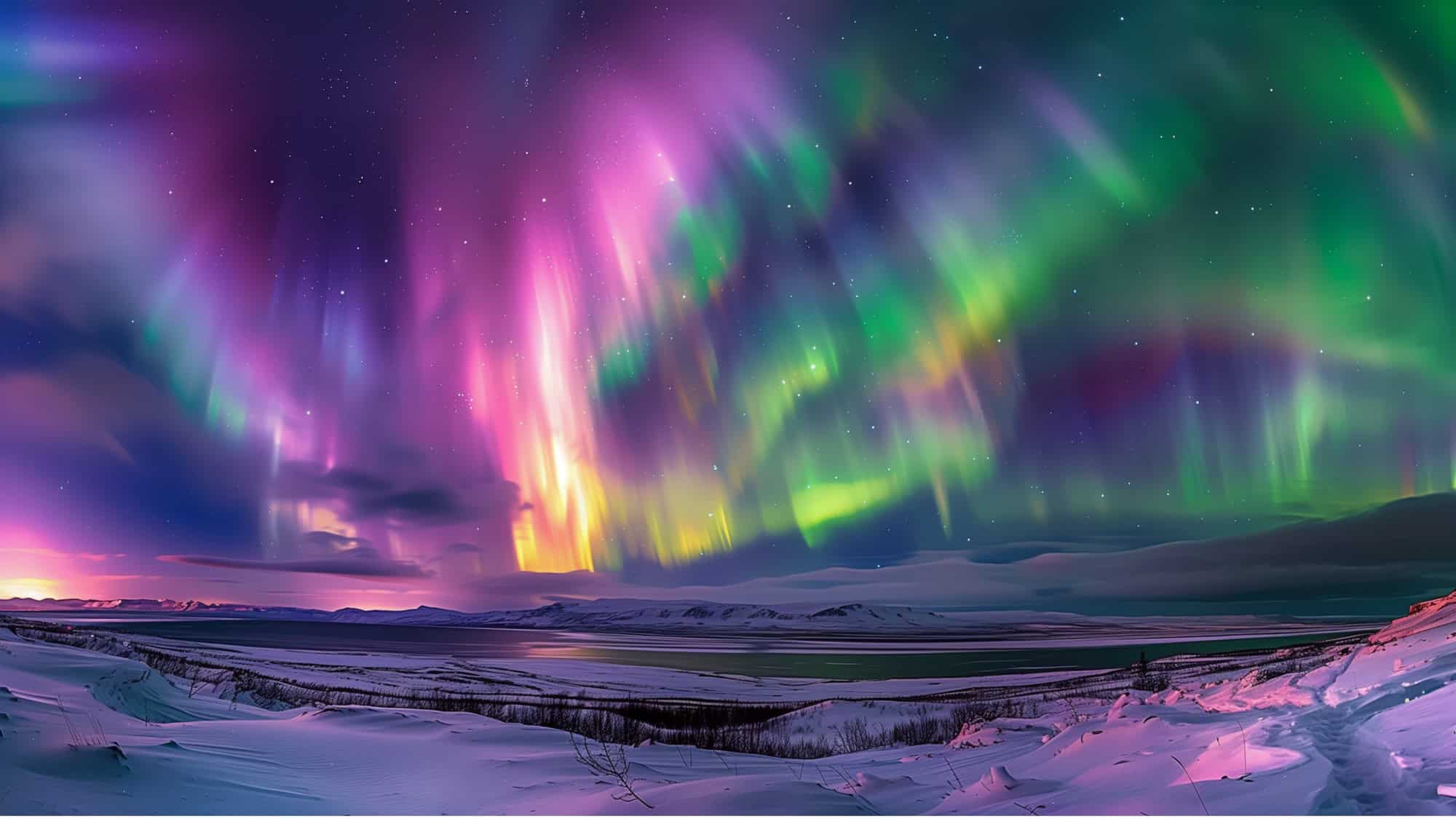
Getting that jaw-dropping photo of the northern lights feels like it should be simple. You just point your camera at the sky and click, right? Wrong. So very wrong.
Returning from a trip to the Arctic with a memory card full of blurry, green-ish smudges is a special kind of disappointment, one that many travelers know all too well. It’s a frustrating outcome after you’ve spent a small fortune on travel and invested hours shivering in a snowbank, waiting for the sky to perform its magic.
But the truth is, your camera does not see the world the way your eyes do, especially not in the pitch-black, freezing-cold darkness of the far north.
Capturing the aurora is less about luck and more about outsmarting your own gear. It requires wrangling a few key settings and knowing which buttons to push, which to ignore, and which to tape down so you do not accidentally bump them with your mittens.
Getting it right turns a frustrating night into an incredibly rewarding one, leaving you with photos that actually do justice to the celestial ballet you witnessed. And you don’t even need to be a professional photographer with a degree in astrophysics.
Instead, you just need a few tips to make your northern lights photos truly unforgettable.
Wide-Angle Lens

You might think your standard kit lens is enough to capture the grandeur of the aurora, but you would be wrong (and I say that with love). The northern lights are massive. They stretch across the entire sky, sometimes directly overhead, and a standard lens just cannot fit it all in.
It is like trying to take a photo of the Grand Canyon through a paper towel roll. You end up missing the scale, the context, and the sheer overwhelming nature of the display.
A wide-angle lens, something in the 14mm to 24mm range, is your best friend here. It allows you to capture not just the lights, but the landscape below (the snowy trees, the frozen lake, or that tiny cabin that gives the sky its sense of proportion).
When you are shopping or renting, look for a lens that is “fast,” meaning it has a wide aperture (more on that later). But the focal length is key. You want to see the arc of the aurora as it stretches from one horizon to the other.
Without a wide-angle lens, you are often forced to stitch multiple photos together in post-processing, which is a headache you do not need when you could be drinking hot cocoa instead.
Plus, the aurora moves. Stitching a moving subject is a recipe for a blurry, disjointed mess that looks more like a modern art project gone wrong than a travel memory. Do yourself a favor and go wide from the start, because nobody wants a panorama that looks like a ransom note.
Long Exposure

Taking a photo of the aurora is not like snapping a picture of your lunch (which we know you also do). You cannot just point, click, and hope for the best.
The camera needs time to gather light. To the human eye, the aurora might look bright, but to a camera sensor, it is still nighttime. So you need to leave the shutter open long enough to let that light soak in.
We are talking about exposure times anywhere from 5 to 20 seconds, depending on how active the lights are. If the aurora is moving fast, you want a shorter exposure (maybe 5-10 seconds) to freeze the structure and details.
Leave it open too long during a fast display, and the lights will just look like a big green smudge (which is cool, but probably not what you are going for unless you love abstract art).
If the lights are faint and slow, you can push that exposure time to 15 or 20 seconds to bring out the colors. But be careful not to go too long. If you expose for 30 seconds or more, the stars will start to trail because of the Earth’s rotation.
High ISO

ISO is your camera’s sensitivity to light. In daylight, you keep this number low (like 100 or 200) to get the cleanest, highest-quality image. But at night, you need to crank that number up. You are asking your camera to see in the dark, so you have to help it out.
For northern lights photography, you will likely be working in the range of ISO 1600 to 3200, or maybe even 6400 if you have a high-end camera that handles noise well.
“Noise” is that grainy, speckled look you get when the ISO is too high. It is the enemy of a crisp photo, but it is often a necessary evil in night photography (sort of like waking up at 3 AM to catch a flight).
Don’t be afraid to push the ISO up. A slightly grainy photo of an amazing aurora is better than a dark, blurry photo where you can’t see anything at all. And most modern cameras are surprisingly good at handling high ISOs.
If you are using an older camera, you might want to stick closer to 1600. It is all about finding the sweet spot for your specific gear. Take a test shot, zoom in on the screen (really zoom in, don’t just squint at it), and check the details.
If it looks like a sandstorm, lower the ISO. If it is pitch black, raise it. It is not rocket science, but it does require a little bit of trial and error in the cold.
Wide Aperture

Remember when I mentioned “fast” lenses earlier? This is where that comes into play.
The aperture is the opening in your lens that lets light through. You want that opening to be as wide as possible to gulp down all that starlight and aurora glow. In camera terms, a wide aperture means a low f-stop number.
You are looking for f/2.8 or lower (like f/1.8 or f/1.4). If your lens only goes down to f/4, you can still get shots, but you will have to compensate with a higher ISO or longer shutter speed, which introduces more noise or blur. It’s a trade-off (isn’t everything in life?).
Shooting wide open at f/2.8 lets in twice as much light as f/4. That is a huge difference when you are dealing with the subtle glow of the ionosphere. It allows you to keep your shutter speed shorter, preserving the distinct pillars and curtains of the aurora rather than turning them into a nebulous wash of color.
Some lenses might be a little soft around the edges when wide open, but honestly, who is looking at the corners when the sky is on fire? Focus on the center sharpness and let the light pour in.
If you are renting a lens for this trip, prioritize that low f-number. It is the single piece of gear spec that makes the biggest difference in night photography.
Focus Manually

Autofocus is amazing for sports, wildlife, and toddlers running around the backyard. It is absolutely useless for the northern lights.
Your camera uses contrast to find focus, and against a pitch-black sky, it will hunt back and forth until you want to scream (or throw it in a snowbank, which I don’t particularly recommend).
So you have to take control. Switch your lens to manual focus (MF). The goal is to focus on “infinity,” which is usually marked with a little ∞ symbol on the lens barrel. However, and this is a big however, true infinity is often not exactly on the line. It might be a hair to the left or right, just to keep you humble.
The best way to nail this is to use “live view” on your camera’s LCD screen. Find the brightest star or a distant city light, zoom in digitally on the screen (not with the lens), and twist the focus ring until that point of light is as small and sharp as possible.
Once you have it, do not touch it. In fact, a little piece of gaffer tape to hold the focus ring in place is a pro move. Nothing is worse than shooting for an hour only to get back to the hotel and realize you nudged the focus ring and every single shot is blurry.
Don’t forget to check your focus periodically throughout the night, too. Temperature changes can sometimes cause the lens elements to shift slightly.
Use A Sturdy Tripod

You simply cannot handhold a camera for a 10-second exposure. I do not care how steady your hands are or how much yoga you do.
You need a tripod, and not just any flimsy piece of plastic you found at a discount store. The Arctic is windy. A lightweight travel tripod might be great for hiking, but it will vibrate like a tuning fork in a stiff breeze, ruining your long exposures.
Instead, you need something with some heft and stability. If your tripod has a hook on the center column, hang your camera bag from it to add weight and anchor it down (just make sure the bag isn’t swinging in the wind like a pendulum).
Also, consider the mechanics of the tripod in the cold. Some twist locks can freeze up or become impossible to operate with thick gloves on. Lever locks are generally easier to manage when your fingers are numb.
And speaking of cold, carbon fiber tripods are nicer to handle than aluminum ones because they do not get quite as painfully cold to the touch. If you have an aluminum tripod, maybe wrap the legs in foam or tape so you don’t freeze your hands to the metal like that kid in A Christmas Story.
Remote Shutter Release
Even with the sturdiest tripod in the world, the simple act of pressing the shutter button creates a tiny vibration. In a long exposure, that vibration can result in “camera shake,” making your stars look like little squiggles instead of pinpoints.
The solution is to not touch the camera at all. And a remote shutter release allows you to trigger the shot with a cable or a wireless remote.
It is a cheap accessory that makes a big difference in sharpness. You can stand there with your hands in your pockets (where they belong) and just click the remote when the lights flare up.
If you do not have a remote, do not panic. You can use the built-in 2-second self-timer on your camera. You press the button, the camera waits two seconds for the vibrations to settle, and then it takes the picture. It is a little slower and can be annoying if the aurora is moving fast and you are trying to catch a specific moment, but it works in a pinch.
Some newer cameras also have apps that let you use your phone as a remote. Just be warned that using your phone in the cold drains its battery incredibly fast, and the bright screen ruins your night vision.
Shoot In RAW

If you are used to shooting in JPEG, now is the time to switch over to RAW. A JPEG file is compressed; the camera takes the data, makes some decisions about color and contrast, and throws away the rest of the information to save space.
A RAW file keeps everything. And when you are shooting the northern lights, you are often dealing with extreme conditions, like very dark foregrounds and bright lights in the sky. So you need all that extra data to recover details in the shadows and fine-tune the white balance later on your computer (because your camera’s auto white balance will inevitably panic).
JPEGs often struggle with the subtle shades of green, purple, and pink in the aurora, sometimes turning them into muddy bands of color. With a RAW file, you have much more latitude to adjust the exposure and color temperature without degrading the image quality.
It gives you a digital safety net.
Yes, the files are larger and fill up your memory card faster, so bring extra cards. But the difference in quality is night and day (pun intended).
You traveled all this way to see the lights; do not let a file format limit how good your photos look. You can always convert them to JPEG later to post on social media and make your coworkers jealous.
Bring Extra Batteries

Batteries hate the cold. It is a chemical fact. A battery that would last all day in Florida might die in 30 minutes in the Arctic Circle. Lithium-ion batteries lose their capacity rapidly when the temperature drops below freezing.
There is nothing (and I mean nothing) more heartbreaking than the sky lighting up with the best display of the decade while your camera blinks “battery” and shuts down. It feels like a personal betrayal.
You need backups. Not just one, but two or three.
Keep your spare batteries warm. Put them in an inside pocket of your jacket, close to your body heat. Do not leave them in the camera bag sitting in the snow.
When the battery in your camera dies, swap it with a warm one from your pocket and put the cold one in your jacket. Sometimes, warming it up will recover a little bit of charge, enough for a few more shots.
Also, turn off any unnecessary features on your camera, like image review (where it shows you the photo after every shot) or WiFi, to save power. Treat your energy like gold. Because when the lights are dancing, you do not want to be fumbling with a dead brick of plastic.
Composition Matters

A photo of just the green sky is nice, but after you have seen three of them, they all start to look the same. The best aurora photos tell a story about where you are. They anchor the celestial show to the earthly ground.
Look for something to include in the foreground. A snow-covered pine tree, a jagged mountain peak, a reflection in a frozen lake, or even your rental car (if it looks cool and isn’t a beige sedan).
These elements give the photo scale and context. They show the viewer that this isn’t just a screensaver; it is a real place.
Scout your location during the day if possible. It is really hard to find a good composition when it is pitch black, and you are trying not to trip over roots (trust me on this one).
Find a spot with a clear view to the north (usually where the lights start), but look for interesting shapes or lines that lead the eye into the frame. If there is a cabin with a warm light in the window, that contrast between the orange artificial light and the green natural light can be stunning.
Just make sure the foreground isn’t so bright that it blows out the exposure. It takes a little more thought than just pointing up, but the results are well worth it.
Check The Moon Phase

The moon is a bit of a frenemy to aurora photographers. A full moon is like a giant floodlight in the sky. It washes out fainter auroras, making it harder to see the subtle colors and structures.
If you are planning your trip solely for the lights, try to aim for a new moon or a crescent moon phase when the skies are darkest. This is when the aurora pops with the most intensity, and you can see the stars clearly.
However, a little bit of moonlight isn’t a disaster. In fact, a quarter moon can actually help illuminate the foreground landscape, saving you from having a pitch-black bottom half of your photo. It lights up the snow and mountains naturally.
So, don’t cancel your trip if the moon is out, but just be aware of how it affects your settings. You might need shorter exposures because the ambient light is brighter.
And avoid shooting directly toward the moon unless you want a massive white flare in your image. Work with it, not against it.
Watch The Weather

You can have the biggest solar storm in history, but if there is a thick layer of clouds, you are not seeing anything but grey fluff. Turns out, the weather is the ultimate gatekeeper of the northern lights.
It is the one factor you cannot control, but you can monitor it obsessively (we all do). Use local weather apps to check for cloud cover.
In places like Iceland or Norway, the weather changes every five minutes. It might be cloudy where you are, but clear ten miles down the road.
Be willing to chase the clear sky. If the forecast says there is a hole in the clouds an hour away, get in the car. Aurora hunting is really just cloud dodging half the time. Look for webcams in different areas to see real-time conditions if possible. And remember that coastal areas often have more changing weather than inland spots.
Unfortunately, sometimes, standing in the freezing wind while waiting for a break in the clouds is just part of the deal. But move when you can. Don’t stay parked under a cloud bank hoping it will move. Go find the stars.
Be Patient

This is the hardest tip to follow. We live in a world of instant gratification, but the aurora operates on cosmic time. You might stand outside for three hours and see nothing but a faint green haze that looks more like a cloud than a light show.
It is cold, you are tired, and your toes are numb. It is easy to give up and go inside. But the lights are unpredictable. They can explode out of nowhere in seconds, dance for ten minutes, and then vanish again.
Some of the best displays happen when you least expect them. Bring warm clothes; we are talking more layers than you think you will ever need. Bring a thermos of something hot. And bring a friend to talk to so you don’t go crazy staring at the dark.
Treat it like a meditation or a vigil. Enjoy the stars, the silence, and the crisp air.
If the lights show up, it is a gift. If they don’t, you still spent a night under the Arctic sky, which is a pretty cool consolation prize. Just don’t go inside until you are absolutely sure the show is over. The moment you close the door is usually when the sky lights up (keep reading to see our experience with this).
Storytime

We learned a very painful lesson about patience (and the importance of thermal underwear) during a trip to Jasper National Park. As it was late September, we checked the aurora forecast app, which practically screamed that we were in for a spectacle.
So we felt incredibly smug as we drove out to a pristine lake spot long before sunset. We set up the tripod, framed the shot with the mountains reflecting in the water, got the focus situated, and waited. And waited.
The temperature dropped faster than my enthusiasm, and soon we were shivering in the dark. We could see a faint green glow on the back of the camera screen, but to the naked eye, it just looked like a slightly weird cloud. It was underwhelming, to say the least.
John eventually hit his limit around midnight. He was cold, cranky, and convinced the app was personally lying to us. He insisted we pack up, and because I could no longer feel my toes, I agreed.
We loaded the gear into the car and started the drive back, blasting the heater. We had been on the road for a mere five minutes when the sky decided to humiliate us. The entire sky exploded in green and purple ribbons, dancing so brightly we could see them through the windshield.
And it went on for fifteen glorious minutes.
Instead of capturing that award-winning shot over the lake, I stood in the hotel parking lot, frantically shooting photos next to a Toyota Corolla.
What did we learn? Next time, we are dressing warmly enough to outlast the cold (and John’s bad mood).
Like Our Content? Follow Us On MSN (or click the Follow Button above) to see more from us.